Monday, 2 April 2012

Work: Merlin Entertainments Group

“The No 1 visitor attraction operator in Europe, No 2 in the world, Merlin Entertainments (Merlin) headquarters are in Poole, Dorset (UK).  Merlin operates an international portfolio of global and local attractions, among them many of the world's best known brand names - Madame Tussauds, The Dungeons, Alton Towers Resort, LEGOLAND, SEA LIFE, Gardaland, The EDF Energy London Eye and many more!

The company's 87attractions, 6 hotels and 2 holiday villages in 19 different countries across four continents; Europe, North America, Australasia and Asia, annually welcome around 46 million visitors, and employ over 17,000 staff.”


I have just completed my 3 week work placement with Merlin Design Studios, London, and I had the most amazing time! The studio contained all the creative minds behind the various brands that Merlin own. I spent 2 weeks working with the SeaLife brand and 1 week working with Resort Theme parks. Due to Merlin’s need for secrecy when it comes to new aspects of their attractions, I won’t be able to show any of the work I did but, but for myself it was an invaluable experience and someday I hope to work for them fulltime.

Now back to reality I have lots of work to catch up on! PGD presentations hear I come.

Sunday, 18 March 2012

Cultural Semiotics

Back in January we had a lecture by Matt Hawthorn looking at amongst other things Semiotics and Culture. The main point I want to talk about that I got from what Matt had to say was the idea of Semiotics and how culture plays its part within the area of semiotics.

Matt defined semiotics as ‘How the world can be viewed’ or ‘How we get meaning from it’.
One definition of Culture is ‘the behaviours and beliefs characteristic of a particular social, ethical or age group’ (dictionary.com)

By viewing semiotics through the use of culture I want to answer the question ‘In my work, can nature be taken too far in abstract design for fantasy purposes, so that it no longer becomes believable?'

In Semiotics there are two parts:  a Signifier and a Signified.
The Signifier is what the ‘thing’ is- so is it an aesthetic piece of art, an experience, an object etc.
The Signified is the meaning of the ‘thing’.

To get from the Signifier to the Signified the viewer must go through a process. My argument is that everyone belongs to some sort of culture, whether that be ethical, age, social, fashion, film, beliefs etc. Therefore everyone can identify something using their cultural experiences- the results may be different but the core semiotic of culture is the same.

For example:


Person A and B look at the signifier, whether that be some art, an object, an event etc They then both form some sort of conclusion or Signified result by using Cultural Semiotics.

Person A may use their past experience of Structure to form a conclusion, whereas Person B may use Politics and come out with a completely different answer; however, by both using their experience of culture, either the same or different, they have gained an experience of the object, and as everyone is part of some sort of culture, everyone can experience something and gain some sort of meaning from it.

Therefore looking back at my original question; ‘In my work, can nature be taken too far in abstract design for fantasy purposes, so that it no longer becomes believable?’ my answer would be no it cannot. Each person throughout their life gains different experiences yet all experience in some way a form of culture. So if I design something nature related each person could view it through the eyes of their culture and from that past experience form some meaning personal to themselves, therefore them accepting it as something.

As long as the design can link with one of the above cultural elements, and as everyone can relate in some way to a type of culture, it would suggest that on some level it can always be believable.


Based on the lecture by Matt Hawthorn, January 23rd 2012, Poetics of Research Practice

Alexander McQueen

Alexander McQueen is one of Britain’s best known Fashion Designers. London born McQueen left school age 16 and was offered an apprenticeship at Savile Row Tailors Anderson and Shephard. In his early twenties he worked for Koji Tatsuno and then became Romeo Gigli’s design assistant. In less the 10 years McQueen became one of the world’s most respected fashion designers.

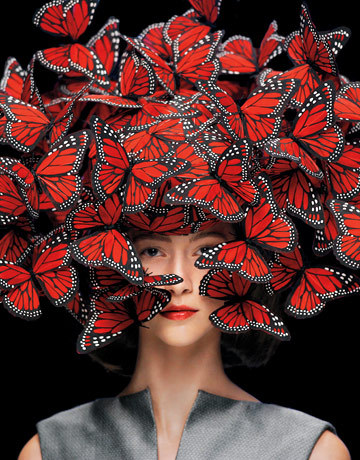
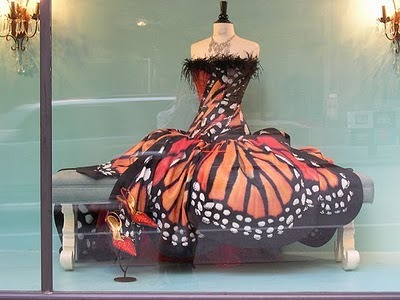
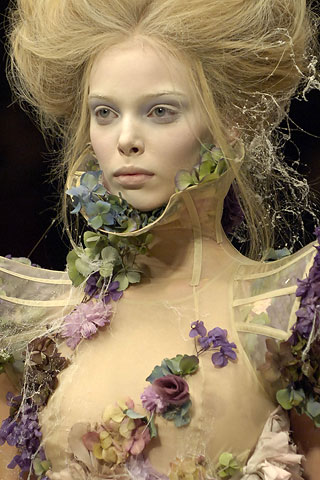
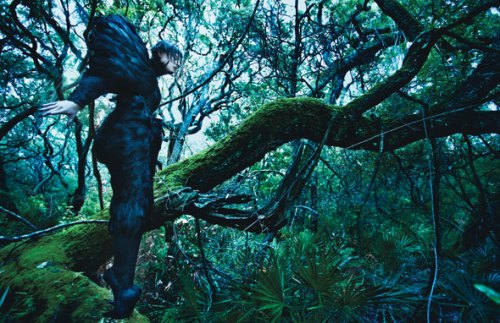
The following are some examples of his work. These particular images use nature as their inspiration and personally I think they are really beautiful. They are a good example of how a designer has used the natural world as their source of inspiration.

Alexander McQueen antler dress accessed 18-03-12

Alexander McQueen bird dress accessed 18-03-12

Alexander McQueen butterfly dress accessed 18-03-12
http://slimpaley.files.wordpress.com/2010/10/alexander-mcqueen03.jpg?w=600

Alexander McQueen butterfly hat accessed 18-03-12
http://26.media.tumblr.com/tumblr_l6e63ry0H71qcmfxio1_400.jpg

Alexander McQueen butterfly shoes accessed 18-03-12
http://www.pushitmagazine.com/1/wp-content/uploads/2010/11/alexander_mcqueen_spring_2011-2_thumb.jpg

Alexander McQueen butterfly wing dress accessed 18-03-12

Alexander McQueen dress accessed 18-03-12

Alexander McQueen dress2 accessed 18-03-12
http://blogs.mirror.co.uk/the-ticket/css/mcQMAIN.jpg

Alexander McQueen flower dress accessed 18-03-12
https://blogger.googleusercontent.com/img/b/R29vZ2xl/AVvXsEiNmnUZa2f7WAKqocDIqv_6VUAKl23R3FLe5rkYicCt6K59AWYO7uhHEcb3nXen0aA3mGA37jk7bb8wM-Ztl1gBF22FFbXGc8wEU71RIFUXpmttUAcr1oCZi-8Y_tyxPd3NYt9hhpraiLw/s1600/Picture+16.png

Alexander McQueen image accessed 18-03-12
http://editorialpursuits.files.wordpress.com/2009/08/w-magazine-sanctuary-alexander-mcqueen.jpg?w=500&h=323

Film Focus: The Truman Show

I was watching the Truman Show on TV the other day and one of the characters said something quite interesting:

“We accept the reality of the world for which we are presented”
Truman Show (1998)

In this context the character was saying that even though the world seemed false to the audience, to Truman (the main character) it was perfectly normal.
This links quite well with my project. If a designer can establish a reality at the start of a film it will make it more believable for the audience. If the characters believe it then the audience will believe it.

Sunday, 26 February 2012

Interview with a Production Designer: John Barry

Production Designer John Barry is best known for his work on Star Wars: Episode IV (1977), A Clockwork Orange (1971) and Superman I (1978) and II (1980). Barry started his career in the Art department on the 1963 epic, Cleopatra, Directed by Joseph L. Mankiewicz, and is now well known in the film industry (IMDB). In 1979 Barry collapsed during filming of Star Wars: Episode V (1980), and later died of meningitis, but his imaginative design work still lives on (IMDB).

I was reading a book the other day and came across an interesting quote by Barry:

“I like doing science fiction and fantasy films. You can let yourself go. I prefer designing surrealist things. I find it much easier, too, because you’re free to choose. When you’re in a jam, you can simply change the rules.”
(Ede, L. 2010. P169)

I think this is a really good quote and really helps me with my project. I agree with Barry that designing surrealist things are much more fun as your imagination is the only limit to what you can create. The last part about how you can “simple change the rules” is perfect for answering my research question. To create fantasy nature you just simply change the rules of real nature. You make water plants live on land, small plants large, large plants small, combine animal species, fuse organic and manmade together, the list goes on.

I can simply... change the rules


Ede, L (2010) British Film Design: A history. I.B.Tauris,

Theory: Dystopia

Dystopia or Cacotopia is defined as “a society characterised by human misery, as squalor, oppression, disease and overcrowding” (Dictionary.com), this is in contrast to the more well-known Utopia meaning “any real or imaginary society, place, state, etc, considered to be perfect or ideal” (World English Dictionary, Dictionary.com).

There are several variations on the dystopian idea, looking at different social elements; society, social groups, politics, economics, nature, caste systems, technology etc. In most cases of the use of Nature in a dystopian society, Nature is considered dangerous, hostile or something to be feared; like in Fahrenheit 451 by Ray Bradbury.

A good example of a Distipian World would be that found in film The Matrix (1999), Directed by the Wachowski brothers. The real world, as opposed to the virtual world of the Matrix, has undergone total destruction by machines, leaving it void of animals and plants. Humans are now grown in huge metal farms for producing energy for the machines, the sky is tainted and the atmosphere pushed out of balanced. A total sense of chaos and destruction has taken over the planet.

Dystopia is a good idea to base the world of Charn on for my project. Jadis, The White Witch, has destroyed all living things in her world using the Deplorable World, leaving behind a dying sun hanging over a deserted palace. Dystopia would fit well in Charn.


Friday, 24 February 2012

Research: Charn

I just put some images together into a mood board to show some possible looks and characteristics I could use for Charn. The images were all created by a Concept Artist called Daniel Dociu (tinfoilgames.com)