Showing posts with label Art. Show all posts

Friday, 20 July 2012

Herbology- Wizarding Plants

The phenomenon that is Harry Potter has taken the world by storm and even though the final film of the final book is now complete, the Potter craze is certainly not over and its franchise is still growing. 400 million copies of the Harry Potter books have been sold worldwide, 6.9 million copies of the Half blood prince were sold in the first 24 hours of its release, the final Deathly Hallows book topped this even further when in the same time period it sold 15 million copies setting a new world record as the quickest-selling book of all time (Money, 2011). To help deliver the fourth Potter book, the Goblet of Fire, the United States alone allocated 9000 FedEx trucks whose sole purpose was to deliver the new book to eager fans. As a result of its immense success, the book’s author, JK Rowling, has totalled a personal fortune over £600million. (Money, 2011)

It’s not just the movie makers who have benefited from the Potter craze, the franchise alone is worth $24,711,000,000 (Statistic Brain, 2011). The video games franchise alone has brought in $1.5 billion of revenue (LEAW, 2011). Ticket sales exceed $7,216million and toy sales in excess of $7,297 million (Statistic Brain, 2011). Overall the Harry Potter market has been incredibly successful, producing 7 books, 8 films and millions of pounds worth of profit to date.

When filming had finished Warner Bros turned their custom build sound stages in London into every Potter fans dream, a Harry Potter Studio tour. A playground of all things Harry Potter, the Warner Bros Studio Tour is expected to have 5000 visitors pass through its magical gates each day (Sun-Times, 2012). Having been given the opportunity myself to go on the tour, I would recommend it to any Potter or film fan as a fantastic day out. The amount of information on show is perfect for any budding film maker or designer, and there is just too much to take in for a single visit.

Here are just a few of the photos I took whilst on the tour:


For the purposes of this piece of writing, however, I am going to investigate the use of Nature in the world of Harry Potter. When is it used, why is it used, and how is it used so successfully.

Plants have been used as ingredients in medicines and healing remedies for hundreds if not thousands of years. It is widely known that many species of plants contain healing properties, from Aloe’s soothing effects on burns, to Fennels aid to digestion (Linsdomain, 2010a). Many cults, groups and religions have taken the medicinal properties of plants to the next level and have even used them for witchcraft, potions and spells. The following are some examples of plants and herbs that have been used for their magical properties:

Vervain- Placing some next to your bed will prevent nightmares.
Wearing a crown of Vervain gives protection when invoking spirits.
When mixed with water and sprinkled round the home, it can drive out evil forces.
Burying Vervain in the garden will make your plants thrive.

Oak- Known as the ancient tree of the druids and also one of the Fairy Triad (being oak, ash and thorn).
Placing acorns in a window will protect you from lightening.
Planting an acorn at night, in the dark of the moon will bring good fortune.

Hazel- Good for making magic wands.

Dandelion- Tea made from ground and roasted dandelion root will give psychic powers and enable the drinker to call up spirits.

Catnip- Used in love spells.
When used as book marks in spell books, catnip will give the magical words strength.

Almonds -Also good for making magic wands as almond is the plant of air, out of which element magic is formed.
(Linsdomain, 2010b)

At Hogwarts school of Witchcraft and Wizardry, Harry Potter and his classmates must attend their very own classes on magical plants. ‘Herbology’ is the study of magical plants and fungi, including their care, magical properties and uses, whether on their own or in potions. (Harry Potter Lexicon, 2012). JK Rowling at various points in the book talks about specific books related to Herbology:

Advanced Potion-Making by Libatius Borage
Encyclopaedia of Toadstools
Flesh-Eating Trees of the World
Magical Drafts and Potions by Arsenius Jigger
Magical Water Plants of the Mediterranean
Most Potent Potions
One Thousand Magical Herbs and Fungi by Phyllida Spore
Toadstool Tales by Beatrix Bloxam
(Harry Potter Lexicon, 2012)

She obviously thought it significant enough in the Wizarding world that books would be written about such things, and that young witches and wizards would be taught about them at school. Magical plants are important to the Wizarding community, or at least in the fantasy world they are. The following is a list of specific magical plants that appear in the books:

A
Abyssinian Shrivelfig
Aconite (Monkshood, Wolfsbane)
Alihotsy
Ash
Aspen
Asphodel
B
Beech
Belladonna
Blackthorn
Black Walnut
Bouncing Bulb
Bubotuber
C
Cabbage
Cedar
Cherry
Chestnut
Cypress
D
Daisy
Devil’s Snare
Dirigible Plum
Dittany
Dogwood
E
Ebony
Elder
Elm
English Oak
F
Fanged Geranium
Fir
Flitterbloom
Flutterby Bush
Fluxweed
G
Gillyweed
Ginger
Gurdyroot
H
Hawthon
Hazel
Hellebore
Holly
Honking Daffodil
Hornbeam
K
Knotgrass
L
Larch
Laurel
Leaping Toadstool
Lovage
M
Mahogany
Mallosweet
Mandragora
Mandrake
Maple
Mimbulus Mimbletonia
Mistletoe Berries
Monkshool
N
Nettle
O
Oak
P
Pear
Peppermint
Pine
Pomegranate
Poplar
Privet
Puffapod
Pumpkin
R
Red Oak
Redwood
Rosewood
Rowan
Rue
S
Sage
Screechsnap
Scurvy-grass
Self-fertilising Shrubs
Silver Lime
Snargaluff Tree
Sneezewort
Sopophorous Bean
Spruce
Sycamore
U
Umbrella-sized Flowers
V
Valerian Roots/Sprigs
Venomous Tentacula
Vine
W
Walnut
Willow
Whomping Willow
Wolfsbane
Wormwood
Y
Yew
(List compiled from Harry Potter Lexicon, 2012)

This is quite a comprehensive list, which suggests it is of some significance within the world of Harry Potter. But it is not only in potions that the world of Harry Potter talks about magical or enchanted vegetation. On the outskirts of the Hogwarts grounds is the Forbidden Forest; described as a thick forest with beech, oak, pine, sycamore and yew. It is also said to contain wild and dangerous creatures like the Acromantulas (giant spiders), Thestrals (not so dangerous but still wild), Fluffy (the three headed dog) and many more (Harry Potter Lexicon, 2012). From its description, it suggests to me that the Forbidden Forest is a place of hiding, filled with mystery and the unknown, a place where animals and creatures dwell in dens, it is their lair and humans are not welcome.
“The forest hides many secrets” (Rowling JK, 1997, pg280)

I think it is this element of the unknown and the mysterious that makes forests and natural environments so magical. It is away from our urban jungles, unlike it, free and unpredictable, and I think this unpredictability is a key factor in what makes nature somehow magical.

This is a concept drawing of the forbidden forest by Andrew Williamson. You can see here how Williamson took inspiration from tropical mangrove roots but adapted them for trees 12-14 feet around (McCabe, 2011, pg339).

McCabe, B (2011) Harry Potter Page to Screen: The Complete Filmmaking Journey. Titan Books, London, Pg 339

In McCabe’s book he quotes the Production Designer for Harry Potter, Stuart Craig saying that he wanted the Forbidden Forest to feel like it had grown out of something real, that it was based on something real.

“The forest is recognisably normal on the outside...but the deeper you penetrate it, the bigger it gets, the more intimidating, the thicker the mist, and the greater the mystery”.
Stuart Craig, Production Designer
(McCabe, 2012, pg339)

I purchased McCabe’s book Harry Potter Page to Screen: The Complete Filmmaking Journey whilst at the Warner Bros Harry Potter Studio Tour. It is reveals an excellent insight into the world of Harry Potter but also into the workings of the film industry, in particular the involvement of the art department.

When I was reading through the book I was particularly looking out for information, opinions and design decisions related to the nature side of the potter world. Some interesting things came from my reading.

“In order to create a believable world, all the places the characters inhabited needed to be credible. To achieve this, the sets needed to feel real, no matter how magical they might be.” (McCabe, 2012, pg323)

This is a quote from Stuart Craig (Production Designer) and I think it is a very good point that he makes. I had read similar ideas throughout conducting my research this year but Craig sums it up well. It links back to one of my previous blog entries after I spoke to Sean Myatt, a Tutor from NTU, and he said that to create fantasy you first need to create reality, its then the process of breaking it where fantasy is created. If we can relate to something in a fantasy film it makes it more easily believed because that element of reality is familiar to us- it’s then only a small jump to accept the fantasy element of the design.

In the fourth film, The Goblet of Fire, Craig talks about the design for the lake environment where the merpeople live. “...they enter the murky underworld of a lake filled with plant life, rocks, and creatures you imagine could exist for hundreds of years deep in a Scottish loch without being discovered and disturbed” (McCabe, 2012, pg129). It’s his use of the word “could” that I think is the key to designing for fantasy.  If you can convince an audience that something fantastic and magical could exist then your job as a designer has been successful. Craig goes on to say later in the book that rather than inventing something new and bizarre, the designs they used in Harry Potter were always exaggerated from something identifiable, “The magic, when it does appear, is all the stronger because it is born out of something that is recognisable. This makes the magic somehow more effective when it finally appears, whether it manifests as ghosts, wand effects, or moving staircases” (McCabe, 2012, pg323). This principal is the same throughout the design, from the exaggerated Gothic architecture of Hogwarts, down to the delicate leaf structures of a Mandrake root. It is all based on the recognisable.

The Mandrake root is a good example of how they have used this principle of starting with a recognisable form and breaking it into the fantasy genre. This concept painting is by Dermot Power and it shows the full body of a baby mandrake:

McCabe, B (2011) Harry Potter Page to Screen: The Complete Filmmaking Journey. Titan Books, London, Pg 426

It’s clear to see that the plant has a humanoid body shape like a baby with leaves growing out of the top. The identifiable element is the baby shape (with matching cries in the film) then the fantasy twist is that it’s actually a baby plant, so has leaves and is made of roots. Part of making something credible is giving it a purpose and a back story. For the mandrake it is that when it is removed from its pot it cries like a baby (with sometimes deadly consequences) but it has a reason for doing that; self defence. Everything in Harry Potter has a back story, a purpose, a history, a reason for being. Even the great Whopping Willow has a purpose for being at Hogwarts; it is revealed in the third book/film that it was planted the year Remus Lupin started Hogwarts as a student, to protect the entrance of a secret passage where Lupin fled during the periods he was due to turn into a werewolf. To make it credible it is given purpose.

Having taken a brief look into the world of Harry Potter and it use of plants, herbs and nature I have found some useful tips for my own work. The work for my MA is almost over but it will be useful for when I continue my research or for future design projects. I think one of the most important things I have established from this research is that nature already has an air of magic about it. It’s mysterious and in areas where there are some large organic structures, like deep forests, the magic is heightened. You don’t need to do a lot to a tree to make it feel a little bit magical. Hattie Storey, Art Director on Potter had this to say about wands, ““I think the more successful wands are organic looking, maybe whittled out of a bit of root or branch...To me, they are more mysterious and magical” (McCabe, 2012, pg481). She feels that the more successful wands, the most magical, the most enchanting looking wands, are those made from natural, organic, branches or roots. Its the ones that look most natural that feel most magical.

Another useful technique Potter has taught me has been to modify the existing. When designing the merpeople concept designer Adam Brockbank said that “Traditionally, there’s a break between the fish part and the human part...but we wanted to create creatures that followed a principle of naturalism and believability, and so we decided not to have that break.” (McCabe, 2012, pg431). They advanced the preconceptions we had of a mermaid and developed it to something new, something different.

The final and I think most important design tool was to start with something identifiable. It’s no good designing a tree that looks nothing like a tree, because the audience won’t believe it and so it will detract from the story. By basing a design on something the audience can relate to they will already have a connection with that object, then when you enhance it or exaggerate it they are much more likely to believe it. If they believe it “could” be possible then it was successful.


LEAW.com, 2011. Harry Potter statistics [online] Available at http://www.leawo.com/blog/2011/07/the-final-adventure-of-harry-potter-and-the-deathly-hallows-part-2-received-over-43-6m-box-office-receipts-abroad-since-the-theater-release/ [Accessed on 17/07/2012

Linsdomain.com, 2010a. Herbs and Plants [online] Available at http://www.linsdomain.com/herbs.htm {Accessed on 17/07/2012]

Linsdomain.com, 2010b. The Magical Properties of Herbs and Plants [online] Available at http://www.linsdomain.com/herbs.htm {Accessed on 17/07/2012]

McCabe, B (2011) Harry Potter Page to Screen: The Complete Filmmaking Journey. Titan Books, London

Money.co.uk, 2011. Twilight vs Harry Potter [online] Available at http://www.money.co.uk/misc/twilight-vs-harry-potter.htm [Accessed on 17/07/2012]

Rowling, J.K (1997) Harry Potter and the Philosopher’s Stone, Bloomsbury, London

Statistic Brain, 2011. Total Harry Potter Franchise Revenue [online] Available at  http://www.statisticbrain.com/total-harry-potter-franchise-revenue/ [Accessed on 17/07/2012]

Sun-Times, 2012. ‘Haryy Potter’ tour opens in London [online] Available at http://www.suntimes.com/entertainment/movies/11617134-421/magic-harry-potter-studio-tour-opens-near-london.html [Accessed on 17/07/2012]

The Harry Potter Lexicon, 2012. Books (and one play) by title [online] Available at http://www.hp-lexicon.org/wizworld/books.html#flesh-eating_trees_of_the_world [Accessed 17/07/12]

The Harry Potter Lexicon, 2012. Herbology [online] Available at http://www.hp-lexicon.org/hogwarts/classes/herbology-class.html [Accessed 17/07/12]

The Harry Potter Lexicon, 2012. The Forbidden Forest [online] Available at http://www.hp-lexicon.org/hogwarts/castle/forest.html [Accessed 17/07/12]

Tuesday, 26 June 2012

Work: Narnia- Gate into the Garden

One of the scenes I am designing for is The Garden. This is where the tree from my previous blog post is situated and where Digory plucks a magic apple for Aslan. The Gate has a fairly basic description in the book, just as being Gold, with silver writing on it and surrounded by a wall made of turf. This Concept visual is to represent that gate.

Sunday, 17 June 2012

Inspiration: Bastion

Bastion, in the words of its creators Supergiant Games, is “an original action role-playing game set in a lush imaginative world” (http://supergiantgames.com/?page_id=242)

I really like the visual look of this game; it’s like a moving digital painting. I can see a similar style of illustration in some of my own renderings. The use of colour in the game is effective also to enhance the fantasy element. I like the use of the isometric style view point- this would be a good way of drawing our map for the Magicians Nephew- the simplified perspective makes it easier to draw and easier to read.

I think it would be a good Idea for myself and Hannah to incorporate some bolder character and set combination illustrations as at the moment they two aspects are quite separate in our designs, some beautifully visualised imagery of a character in an environment might help us tie the two aspects together.


I particularly like this image as it seems to bring elements from all the environments within the game into a single representational image- at a glance it shows all the environments. Id quite like to produce something like this but it will have to wait till the end, as I still haven’t designed all the environments yet.

All images from  http://supergiantgames.com/?page_id=242


Friday, 15 June 2012

Work: Wood between the Worlds SECOND render

Render number two, this is slightly more what I envisioned in my head but I still don’t think its right- yes it shows the look but it doesn’t quite feel like it’s giving enough information. I might do some tree concepts to try and explain the Idea a bit more; this would help give a wider picture of the whole design...I’m conscious that I'm running out of time though so it may have to do.


Tuesday, 8 May 2012

Work: Some more Flora

The concept designs for some Narnian plants are getting nicely underway. Here are the latest developments in the world of plants.

These first sets of 4 trees are designed to be decorative trees. They are very well trimmed and naturally quite ordered in their appearance. They could be suitable for the Garden Scene I am designing for later but for the moment I’m quite happy with letting them sit on the back burner for a bit.

The Bare Birch is a nocturnal plant, in that during the day it looks like a leafless twig, but at night it comes alive, emitting a turquoise glow from its sap that gathers in pockets on its branches. This creates the illusion of glowing leaves, only visible in the darkness.


This is a Candelabra Birch. Still a member of the Birch species it has the distinct white bark. The Candelabra is so named because of its branch structure which forms vertical catkins that grow upwards like candles.


This is a Fire Bud Tree. Its delicate leaves grow upwards, matting together to create a plume-like head, which resembles a tongue of flame.


The final decorative tree is the Flowering Horn. This simple leafed bushy plant grows naturally into the pronged form, where a single rose-like flower blooms all year round. If the flower is removed the plant withers.


This walking tree is one of the talking trees chosen by Aslan himself to become part of the Council to help look after Narnia. Its distinct yellow colouring is present in all the council members, distinguishing them from the other inhabitants of Narnia.


This is my second rendering of the Glowing mushroom- I tried to soften some of the edges under the mushroom to make it look a bit more organic and less strait edged. I think it works better now these changes have been made.


This final plant is my first water based plant. The Semi-Aquatic Giant Lily grows out of the water until it suspends itself by its strong roots above the water’s surface. This plant still needs a little bit more of a back story about its purpose etc


Sunday, 18 March 2012

Cultural Semiotics

Back in January we had a lecture by Matt Hawthorn looking at amongst other things Semiotics and Culture. The main point I want to talk about that I got from what Matt had to say was the idea of Semiotics and how culture plays its part within the area of semiotics.

Matt defined semiotics as ‘How the world can be viewed’ or ‘How we get meaning from it’.
One definition of Culture is ‘the behaviours and beliefs characteristic of a particular social, ethical or age group’ (dictionary.com)

By viewing semiotics through the use of culture I want to answer the question ‘In my work, can nature be taken too far in abstract design for fantasy purposes, so that it no longer becomes believable?'

In Semiotics there are two parts:  a Signifier and a Signified.
The Signifier is what the ‘thing’ is- so is it an aesthetic piece of art, an experience, an object etc.
The Signified is the meaning of the ‘thing’.

To get from the Signifier to the Signified the viewer must go through a process. My argument is that everyone belongs to some sort of culture, whether that be ethical, age, social, fashion, film, beliefs etc. Therefore everyone can identify something using their cultural experiences- the results may be different but the core semiotic of culture is the same.

For example:


Person A and B look at the signifier, whether that be some art, an object, an event etc They then both form some sort of conclusion or Signified result by using Cultural Semiotics.

Person A may use their past experience of Structure to form a conclusion, whereas Person B may use Politics and come out with a completely different answer; however, by both using their experience of culture, either the same or different, they have gained an experience of the object, and as everyone is part of some sort of culture, everyone can experience something and gain some sort of meaning from it.

Therefore looking back at my original question; ‘In my work, can nature be taken too far in abstract design for fantasy purposes, so that it no longer becomes believable?’ my answer would be no it cannot. Each person throughout their life gains different experiences yet all experience in some way a form of culture. So if I design something nature related each person could view it through the eyes of their culture and from that past experience form some meaning personal to themselves, therefore them accepting it as something.

As long as the design can link with one of the above cultural elements, and as everyone can relate in some way to a type of culture, it would suggest that on some level it can always be believable.


Based on the lecture by Matt Hawthorn, January 23rd 2012, Poetics of Research Practice

Alexander McQueen

Alexander McQueen is one of Britain’s best known Fashion Designers. London born McQueen left school age 16 and was offered an apprenticeship at Savile Row Tailors Anderson and Shephard. In his early twenties he worked for Koji Tatsuno and then became Romeo Gigli’s design assistant. In less the 10 years McQueen became one of the world’s most respected fashion designers.

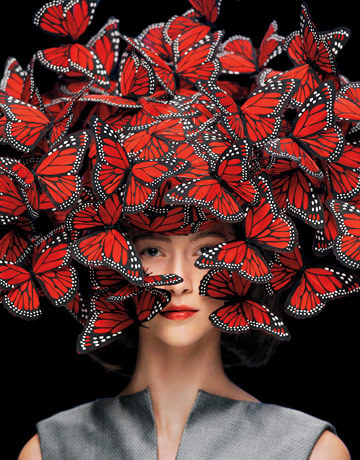
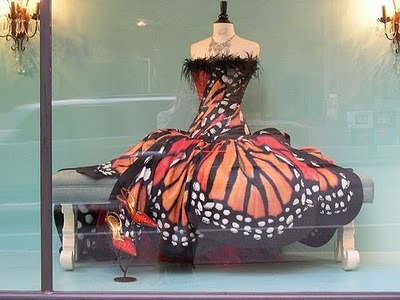
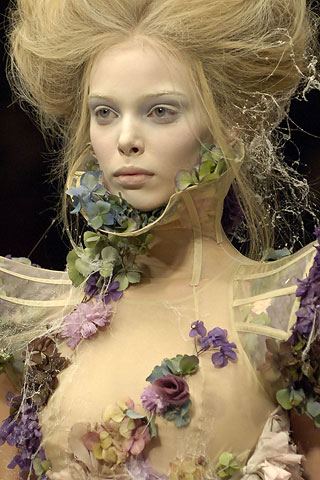
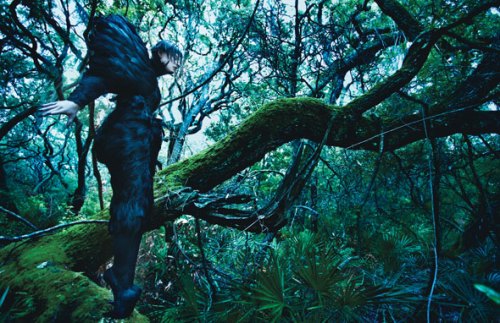
The following are some examples of his work. These particular images use nature as their inspiration and personally I think they are really beautiful. They are a good example of how a designer has used the natural world as their source of inspiration.

Alexander McQueen antler dress accessed 18-03-12

Alexander McQueen bird dress accessed 18-03-12

Alexander McQueen butterfly dress accessed 18-03-12
http://slimpaley.files.wordpress.com/2010/10/alexander-mcqueen03.jpg?w=600

Alexander McQueen butterfly hat accessed 18-03-12
http://26.media.tumblr.com/tumblr_l6e63ry0H71qcmfxio1_400.jpg

Alexander McQueen butterfly shoes accessed 18-03-12
http://www.pushitmagazine.com/1/wp-content/uploads/2010/11/alexander_mcqueen_spring_2011-2_thumb.jpg

Alexander McQueen butterfly wing dress accessed 18-03-12

Alexander McQueen dress accessed 18-03-12

Alexander McQueen dress2 accessed 18-03-12
http://blogs.mirror.co.uk/the-ticket/css/mcQMAIN.jpg

Alexander McQueen flower dress accessed 18-03-12
https://blogger.googleusercontent.com/img/b/R29vZ2xl/AVvXsEiNmnUZa2f7WAKqocDIqv_6VUAKl23R3FLe5rkYicCt6K59AWYO7uhHEcb3nXen0aA3mGA37jk7bb8wM-Ztl1gBF22FFbXGc8wEU71RIFUXpmttUAcr1oCZi-8Y_tyxPd3NYt9hhpraiLw/s1600/Picture+16.png

Alexander McQueen image accessed 18-03-12
http://editorialpursuits.files.wordpress.com/2009/08/w-magazine-sanctuary-alexander-mcqueen.jpg?w=500&h=323

Friday, 17 February 2012

Alice: Madness Returns


"...the worlds that Alice leaps around are stunning, mind bending, and unbelievably cool."
GamePro.com


I recently purchased a book called The Art of Alice: Madness Returns. It’s the design accompaniment for the Video game by American McGee and Spicy Horse Games. The story behind the game is that Alice has recovered from psychotic episode in which she was locked away in an asylum. The game is based on her realisation that the death of her family, for which she blamed herself causing her breakdown, was in fact the doings of another. Just as her own world has been turned upside down and ruined, her beloved Wonderland has also been taken over by a dark force rendering it evil, twisted and on the verge of collapse. Alice must find the evil in both Wonderland and the real world in order to survive.

Ken Wong was the Art Director for Alice: Madness Returns, American McGee and the design team at Spicy Horse Games produced the Art Of book showing stunning visuals and descriptions of the process they went through to create the beautiful yet frightening world of New Wonderland.

The Following is a trailer advertising the game and showing many of the environments Spicy Horse designed for gamers to explore:


Here are some of the images taken from the book that are significant for my own project of the Magicians Nephew:

Martins F, Kerslake B, Lei H, Lei (ART) J, Melo (ART) L (2011) Art of Alice: Madness Returns. Dark Horse Books, Milwaukie


This is the Cover design for the Art Of book. It instantly captures the mood of the game and what people can expect as the venture into the world of Wonderland. This is a good way of showing for a film (or in this case a game), what kind of atmosphere and visual impact a production is going to make.

This is an early exploration for the forest environment by Sun GuoLiang. I love the idea of a floating forest or tree structure, existing in the clouds above us. It feels quite magical.

I like the use of colour in this visual. The monotone effect with a single focus colour works well to create an exciting atmosphere.

This is a good example of clockpunk being graphed onto organic elements. Clockpunk is one of the styles we are going to incorporate into our telling of The Magicians Nephew so as a visual reference of how this can be effectively done this image is useful.

Another example of clockwork being fused with nature (inside the trees).

Again I like the use of colour in this image. The chrome base with highlights of blue work well to create a sinister atmosphere. I also like the illustration of the Caterpillar- this looks like it was done using a graphics tablet.

MAPS!!! Its all about Maps! We really want to create a Map for MN showing how the all the worlds around Narnia link together through The Wood Between The Worlds. This would not only be a useful visual explanation of how the story proceeds but it also has the potential for a beautiful visual.

Another stunning visual incorporating Clockwork. I like the panoramic quality this visual has and good use of colour.

Some examples of how the design department made trees look more 'fantasy-like'- using a stylised colour pallet, mushroom-like canopies and placing it on top of a giant snail.

Nice monochrome visual with a single colour to add significance.

I like the composition of this image- the dark ship at the bottom and swirling light effects overhead.

Nice use of contrasting colours with the Blue being the main colour of the image with highlights of orange. We wanted to use contrasting colours in our design to create drama.

The oriental style motif works well here and its stand-alone nature makes it a nice example of how I could sketch develope ideas before I place them into an exact environment.

This is a good idea for how we could design the elements for Charn (the dying world)- the tower formations would look good as the twisted towers of Charn and the figure heads are useful for Hannah when she looks at the statues of the kings and queens found in Charn's Great Hall.

I like the way this image of the Queen of Hearts Castle has been rendered- it looks like photo collage and illustration combined- the photos give it a realy nice texture giving the whole thing a rough and gritty feel about it.

This is a Colour Script they created to show the different colour schemes and moods through all the different worlds. This is good practice used in the film industry also to show at a glance the kind of mood each location has or needs. We will produce one of these for MN.


I’ve really enjoyed looking through this book- they have made some stunning images and really creative ideas for the environments. I will try and take on board some of their techniques when I do some of the designing for MN. I think Atmosphere is one of the most important things I’ve got from looking through the book- without an appropriate atmosphere a scene will have no depth and won’t look visually interesting, without atmosphere the storytelling cannot be enhanced.