Showing posts with label Theory. Show all posts

Friday, 20 July 2012

Herbology- Wizarding Plants

The phenomenon that is Harry Potter has taken the world by storm and even though the final film of the final book is now complete, the Potter craze is certainly not over and its franchise is still growing. 400 million copies of the Harry Potter books have been sold worldwide, 6.9 million copies of the Half blood prince were sold in the first 24 hours of its release, the final Deathly Hallows book topped this even further when in the same time period it sold 15 million copies setting a new world record as the quickest-selling book of all time (Money, 2011). To help deliver the fourth Potter book, the Goblet of Fire, the United States alone allocated 9000 FedEx trucks whose sole purpose was to deliver the new book to eager fans. As a result of its immense success, the book’s author, JK Rowling, has totalled a personal fortune over £600million. (Money, 2011)

It’s not just the movie makers who have benefited from the Potter craze, the franchise alone is worth $24,711,000,000 (Statistic Brain, 2011). The video games franchise alone has brought in $1.5 billion of revenue (LEAW, 2011). Ticket sales exceed $7,216million and toy sales in excess of $7,297 million (Statistic Brain, 2011). Overall the Harry Potter market has been incredibly successful, producing 7 books, 8 films and millions of pounds worth of profit to date.

When filming had finished Warner Bros turned their custom build sound stages in London into every Potter fans dream, a Harry Potter Studio tour. A playground of all things Harry Potter, the Warner Bros Studio Tour is expected to have 5000 visitors pass through its magical gates each day (Sun-Times, 2012). Having been given the opportunity myself to go on the tour, I would recommend it to any Potter or film fan as a fantastic day out. The amount of information on show is perfect for any budding film maker or designer, and there is just too much to take in for a single visit.

Here are just a few of the photos I took whilst on the tour:


For the purposes of this piece of writing, however, I am going to investigate the use of Nature in the world of Harry Potter. When is it used, why is it used, and how is it used so successfully.

Plants have been used as ingredients in medicines and healing remedies for hundreds if not thousands of years. It is widely known that many species of plants contain healing properties, from Aloe’s soothing effects on burns, to Fennels aid to digestion (Linsdomain, 2010a). Many cults, groups and religions have taken the medicinal properties of plants to the next level and have even used them for witchcraft, potions and spells. The following are some examples of plants and herbs that have been used for their magical properties:

Vervain- Placing some next to your bed will prevent nightmares.
Wearing a crown of Vervain gives protection when invoking spirits.
When mixed with water and sprinkled round the home, it can drive out evil forces.
Burying Vervain in the garden will make your plants thrive.

Oak- Known as the ancient tree of the druids and also one of the Fairy Triad (being oak, ash and thorn).
Placing acorns in a window will protect you from lightening.
Planting an acorn at night, in the dark of the moon will bring good fortune.

Hazel- Good for making magic wands.

Dandelion- Tea made from ground and roasted dandelion root will give psychic powers and enable the drinker to call up spirits.

Catnip- Used in love spells.
When used as book marks in spell books, catnip will give the magical words strength.

Almonds -Also good for making magic wands as almond is the plant of air, out of which element magic is formed.
(Linsdomain, 2010b)

At Hogwarts school of Witchcraft and Wizardry, Harry Potter and his classmates must attend their very own classes on magical plants. ‘Herbology’ is the study of magical plants and fungi, including their care, magical properties and uses, whether on their own or in potions. (Harry Potter Lexicon, 2012). JK Rowling at various points in the book talks about specific books related to Herbology:

Advanced Potion-Making by Libatius Borage
Encyclopaedia of Toadstools
Flesh-Eating Trees of the World
Magical Drafts and Potions by Arsenius Jigger
Magical Water Plants of the Mediterranean
Most Potent Potions
One Thousand Magical Herbs and Fungi by Phyllida Spore
Toadstool Tales by Beatrix Bloxam
(Harry Potter Lexicon, 2012)

She obviously thought it significant enough in the Wizarding world that books would be written about such things, and that young witches and wizards would be taught about them at school. Magical plants are important to the Wizarding community, or at least in the fantasy world they are. The following is a list of specific magical plants that appear in the books:

A
Abyssinian Shrivelfig
Aconite (Monkshood, Wolfsbane)
Alihotsy
Ash
Aspen
Asphodel
B
Beech
Belladonna
Blackthorn
Black Walnut
Bouncing Bulb
Bubotuber
C
Cabbage
Cedar
Cherry
Chestnut
Cypress
D
Daisy
Devil’s Snare
Dirigible Plum
Dittany
Dogwood
E
Ebony
Elder
Elm
English Oak
F
Fanged Geranium
Fir
Flitterbloom
Flutterby Bush
Fluxweed
G
Gillyweed
Ginger
Gurdyroot
H
Hawthon
Hazel
Hellebore
Holly
Honking Daffodil
Hornbeam
K
Knotgrass
L
Larch
Laurel
Leaping Toadstool
Lovage
M
Mahogany
Mallosweet
Mandragora
Mandrake
Maple
Mimbulus Mimbletonia
Mistletoe Berries
Monkshool
N
Nettle
O
Oak
P
Pear
Peppermint
Pine
Pomegranate
Poplar
Privet
Puffapod
Pumpkin
R
Red Oak
Redwood
Rosewood
Rowan
Rue
S
Sage
Screechsnap
Scurvy-grass
Self-fertilising Shrubs
Silver Lime
Snargaluff Tree
Sneezewort
Sopophorous Bean
Spruce
Sycamore
U
Umbrella-sized Flowers
V
Valerian Roots/Sprigs
Venomous Tentacula
Vine
W
Walnut
Willow
Whomping Willow
Wolfsbane
Wormwood
Y
Yew
(List compiled from Harry Potter Lexicon, 2012)

This is quite a comprehensive list, which suggests it is of some significance within the world of Harry Potter. But it is not only in potions that the world of Harry Potter talks about magical or enchanted vegetation. On the outskirts of the Hogwarts grounds is the Forbidden Forest; described as a thick forest with beech, oak, pine, sycamore and yew. It is also said to contain wild and dangerous creatures like the Acromantulas (giant spiders), Thestrals (not so dangerous but still wild), Fluffy (the three headed dog) and many more (Harry Potter Lexicon, 2012). From its description, it suggests to me that the Forbidden Forest is a place of hiding, filled with mystery and the unknown, a place where animals and creatures dwell in dens, it is their lair and humans are not welcome.
“The forest hides many secrets” (Rowling JK, 1997, pg280)

I think it is this element of the unknown and the mysterious that makes forests and natural environments so magical. It is away from our urban jungles, unlike it, free and unpredictable, and I think this unpredictability is a key factor in what makes nature somehow magical.

This is a concept drawing of the forbidden forest by Andrew Williamson. You can see here how Williamson took inspiration from tropical mangrove roots but adapted them for trees 12-14 feet around (McCabe, 2011, pg339).

McCabe, B (2011) Harry Potter Page to Screen: The Complete Filmmaking Journey. Titan Books, London, Pg 339

In McCabe’s book he quotes the Production Designer for Harry Potter, Stuart Craig saying that he wanted the Forbidden Forest to feel like it had grown out of something real, that it was based on something real.

“The forest is recognisably normal on the outside...but the deeper you penetrate it, the bigger it gets, the more intimidating, the thicker the mist, and the greater the mystery”.
Stuart Craig, Production Designer
(McCabe, 2012, pg339)

I purchased McCabe’s book Harry Potter Page to Screen: The Complete Filmmaking Journey whilst at the Warner Bros Harry Potter Studio Tour. It is reveals an excellent insight into the world of Harry Potter but also into the workings of the film industry, in particular the involvement of the art department.

When I was reading through the book I was particularly looking out for information, opinions and design decisions related to the nature side of the potter world. Some interesting things came from my reading.

“In order to create a believable world, all the places the characters inhabited needed to be credible. To achieve this, the sets needed to feel real, no matter how magical they might be.” (McCabe, 2012, pg323)

This is a quote from Stuart Craig (Production Designer) and I think it is a very good point that he makes. I had read similar ideas throughout conducting my research this year but Craig sums it up well. It links back to one of my previous blog entries after I spoke to Sean Myatt, a Tutor from NTU, and he said that to create fantasy you first need to create reality, its then the process of breaking it where fantasy is created. If we can relate to something in a fantasy film it makes it more easily believed because that element of reality is familiar to us- it’s then only a small jump to accept the fantasy element of the design.

In the fourth film, The Goblet of Fire, Craig talks about the design for the lake environment where the merpeople live. “...they enter the murky underworld of a lake filled with plant life, rocks, and creatures you imagine could exist for hundreds of years deep in a Scottish loch without being discovered and disturbed” (McCabe, 2012, pg129). It’s his use of the word “could” that I think is the key to designing for fantasy.  If you can convince an audience that something fantastic and magical could exist then your job as a designer has been successful. Craig goes on to say later in the book that rather than inventing something new and bizarre, the designs they used in Harry Potter were always exaggerated from something identifiable, “The magic, when it does appear, is all the stronger because it is born out of something that is recognisable. This makes the magic somehow more effective when it finally appears, whether it manifests as ghosts, wand effects, or moving staircases” (McCabe, 2012, pg323). This principal is the same throughout the design, from the exaggerated Gothic architecture of Hogwarts, down to the delicate leaf structures of a Mandrake root. It is all based on the recognisable.

The Mandrake root is a good example of how they have used this principle of starting with a recognisable form and breaking it into the fantasy genre. This concept painting is by Dermot Power and it shows the full body of a baby mandrake:

McCabe, B (2011) Harry Potter Page to Screen: The Complete Filmmaking Journey. Titan Books, London, Pg 426

It’s clear to see that the plant has a humanoid body shape like a baby with leaves growing out of the top. The identifiable element is the baby shape (with matching cries in the film) then the fantasy twist is that it’s actually a baby plant, so has leaves and is made of roots. Part of making something credible is giving it a purpose and a back story. For the mandrake it is that when it is removed from its pot it cries like a baby (with sometimes deadly consequences) but it has a reason for doing that; self defence. Everything in Harry Potter has a back story, a purpose, a history, a reason for being. Even the great Whopping Willow has a purpose for being at Hogwarts; it is revealed in the third book/film that it was planted the year Remus Lupin started Hogwarts as a student, to protect the entrance of a secret passage where Lupin fled during the periods he was due to turn into a werewolf. To make it credible it is given purpose.

Having taken a brief look into the world of Harry Potter and it use of plants, herbs and nature I have found some useful tips for my own work. The work for my MA is almost over but it will be useful for when I continue my research or for future design projects. I think one of the most important things I have established from this research is that nature already has an air of magic about it. It’s mysterious and in areas where there are some large organic structures, like deep forests, the magic is heightened. You don’t need to do a lot to a tree to make it feel a little bit magical. Hattie Storey, Art Director on Potter had this to say about wands, ““I think the more successful wands are organic looking, maybe whittled out of a bit of root or branch...To me, they are more mysterious and magical” (McCabe, 2012, pg481). She feels that the more successful wands, the most magical, the most enchanting looking wands, are those made from natural, organic, branches or roots. Its the ones that look most natural that feel most magical.

Another useful technique Potter has taught me has been to modify the existing. When designing the merpeople concept designer Adam Brockbank said that “Traditionally, there’s a break between the fish part and the human part...but we wanted to create creatures that followed a principle of naturalism and believability, and so we decided not to have that break.” (McCabe, 2012, pg431). They advanced the preconceptions we had of a mermaid and developed it to something new, something different.

The final and I think most important design tool was to start with something identifiable. It’s no good designing a tree that looks nothing like a tree, because the audience won’t believe it and so it will detract from the story. By basing a design on something the audience can relate to they will already have a connection with that object, then when you enhance it or exaggerate it they are much more likely to believe it. If they believe it “could” be possible then it was successful.


LEAW.com, 2011. Harry Potter statistics [online] Available at http://www.leawo.com/blog/2011/07/the-final-adventure-of-harry-potter-and-the-deathly-hallows-part-2-received-over-43-6m-box-office-receipts-abroad-since-the-theater-release/ [Accessed on 17/07/2012

Linsdomain.com, 2010a. Herbs and Plants [online] Available at http://www.linsdomain.com/herbs.htm {Accessed on 17/07/2012]

Linsdomain.com, 2010b. The Magical Properties of Herbs and Plants [online] Available at http://www.linsdomain.com/herbs.htm {Accessed on 17/07/2012]

McCabe, B (2011) Harry Potter Page to Screen: The Complete Filmmaking Journey. Titan Books, London

Money.co.uk, 2011. Twilight vs Harry Potter [online] Available at http://www.money.co.uk/misc/twilight-vs-harry-potter.htm [Accessed on 17/07/2012]

Rowling, J.K (1997) Harry Potter and the Philosopher’s Stone, Bloomsbury, London

Statistic Brain, 2011. Total Harry Potter Franchise Revenue [online] Available at  http://www.statisticbrain.com/total-harry-potter-franchise-revenue/ [Accessed on 17/07/2012]

Sun-Times, 2012. ‘Haryy Potter’ tour opens in London [online] Available at http://www.suntimes.com/entertainment/movies/11617134-421/magic-harry-potter-studio-tour-opens-near-london.html [Accessed on 17/07/2012]

The Harry Potter Lexicon, 2012. Books (and one play) by title [online] Available at http://www.hp-lexicon.org/wizworld/books.html#flesh-eating_trees_of_the_world [Accessed 17/07/12]

The Harry Potter Lexicon, 2012. Herbology [online] Available at http://www.hp-lexicon.org/hogwarts/classes/herbology-class.html [Accessed 17/07/12]

The Harry Potter Lexicon, 2012. The Forbidden Forest [online] Available at http://www.hp-lexicon.org/hogwarts/castle/forest.html [Accessed 17/07/12]

Monday, 9 April 2012

Theory: Urban Fantasy

Urban fantasy is a sub-genre of fantasy. One of its main characteristics, as the name suggests, is that it is set in an urban environment, typically a city. Unlike some fantasy storylines set in the wilderness or on alien planets, Urban fantasy comes the added storylines of social etiquette, political complications and all the social implications that come with Urban living.

An example:
“If Jon slays a witch in the middle of the wilderness, and no one hears her fall, there aren't any consequences for Jon. On the other hand, if Jon slays Morgawse, who happens to be the mother of King Arthur and of his son Mordred, not to mention a political force in her own right as ruler of Orkney, Jon must deal with political and emotional fallout. If he hides his deed, he must worry about discovery; if he flees to France and from there across Europe to the Holy Land, he'll have adventures along the way; if he sticks around and boasts of his prowess, he earns Mordred's wrath and puts Arthur in a difficult spot.” 
(http://www.writing-world.com/sf/contemporary.shtml)

Urban fantasy can come in many different styles; aliens invading modern cities, mythological creatures invading settlements, alternate universes where magic and civilisation live in harmony, modern times where the magic community live in hiding unknown to most people. A popular example of the latter is Harry Potter where wizards, witches and monsters live unnoticed by ordinary humans but dwell among us in hiding.

Urban fantasy does not have to be confined to modern cities and times however. Authors Marie Brennan and Cassandra Clare have been known to use urban fantasy in Elizabethan and Victorian settings. It is still Urban Fantasy because of the location it is set and the social implications that come with it.

I have looked at Urban Fantasy as a possible setting for Charn where the white witch used to live. The back story of Charn could be that magic, monsters and witches lived in plain sight of ordinary life. So when I design the sets for Charn I could have dead people, monsters and wizards all in the same place within the city, as if magic and monsters was the norm.

Sunday, 18 March 2012

Cultural Semiotics

Back in January we had a lecture by Matt Hawthorn looking at amongst other things Semiotics and Culture. The main point I want to talk about that I got from what Matt had to say was the idea of Semiotics and how culture plays its part within the area of semiotics.

Matt defined semiotics as ‘How the world can be viewed’ or ‘How we get meaning from it’.
One definition of Culture is ‘the behaviours and beliefs characteristic of a particular social, ethical or age group’ (dictionary.com)

By viewing semiotics through the use of culture I want to answer the question ‘In my work, can nature be taken too far in abstract design for fantasy purposes, so that it no longer becomes believable?'

In Semiotics there are two parts:  a Signifier and a Signified.
The Signifier is what the ‘thing’ is- so is it an aesthetic piece of art, an experience, an object etc.
The Signified is the meaning of the ‘thing’.

To get from the Signifier to the Signified the viewer must go through a process. My argument is that everyone belongs to some sort of culture, whether that be ethical, age, social, fashion, film, beliefs etc. Therefore everyone can identify something using their cultural experiences- the results may be different but the core semiotic of culture is the same.

For example:


Person A and B look at the signifier, whether that be some art, an object, an event etc They then both form some sort of conclusion or Signified result by using Cultural Semiotics.

Person A may use their past experience of Structure to form a conclusion, whereas Person B may use Politics and come out with a completely different answer; however, by both using their experience of culture, either the same or different, they have gained an experience of the object, and as everyone is part of some sort of culture, everyone can experience something and gain some sort of meaning from it.

Therefore looking back at my original question; ‘In my work, can nature be taken too far in abstract design for fantasy purposes, so that it no longer becomes believable?’ my answer would be no it cannot. Each person throughout their life gains different experiences yet all experience in some way a form of culture. So if I design something nature related each person could view it through the eyes of their culture and from that past experience form some meaning personal to themselves, therefore them accepting it as something.

As long as the design can link with one of the above cultural elements, and as everyone can relate in some way to a type of culture, it would suggest that on some level it can always be believable.


Based on the lecture by Matt Hawthorn, January 23rd 2012, Poetics of Research Practice

Film Focus: The Truman Show

I was watching the Truman Show on TV the other day and one of the characters said something quite interesting:

“We accept the reality of the world for which we are presented”
Truman Show (1998)

In this context the character was saying that even though the world seemed false to the audience, to Truman (the main character) it was perfectly normal.
This links quite well with my project. If a designer can establish a reality at the start of a film it will make it more believable for the audience. If the characters believe it then the audience will believe it.

Sunday, 26 February 2012

Theory: Dystopia

Dystopia or Cacotopia is defined as “a society characterised by human misery, as squalor, oppression, disease and overcrowding” (Dictionary.com), this is in contrast to the more well-known Utopia meaning “any real or imaginary society, place, state, etc, considered to be perfect or ideal” (World English Dictionary, Dictionary.com).

There are several variations on the dystopian idea, looking at different social elements; society, social groups, politics, economics, nature, caste systems, technology etc. In most cases of the use of Nature in a dystopian society, Nature is considered dangerous, hostile or something to be feared; like in Fahrenheit 451 by Ray Bradbury.

A good example of a Distipian World would be that found in film The Matrix (1999), Directed by the Wachowski brothers. The real world, as opposed to the virtual world of the Matrix, has undergone total destruction by machines, leaving it void of animals and plants. Humans are now grown in huge metal farms for producing energy for the machines, the sky is tainted and the atmosphere pushed out of balanced. A total sense of chaos and destruction has taken over the planet.

Dystopia is a good idea to base the world of Charn on for my project. Jadis, The White Witch, has destroyed all living things in her world using the Deplorable World, leaving behind a dying sun hanging over a deserted palace. Dystopia would fit well in Charn.


Friday, 25 November 2011

Theory: The Gaia Theory

"Shall I not have intelligence with the earth? Am I not partly leaves and vegetable mould myself"
Henry David Thoreau


The Gaia Theory, formulated by James Lovelock, a chemist and futurist from Devon England, proposes that all organic life on earth along with their surroundings are all closely connected to form a self regulating system that maintains all life on the planet. This theory which was once mocked by the scientific community is now becoming much more widely accepted and developed.

Many adaptations of this theory have been woven into the stories of many successful fantasy films. Miyazaki Hayao has been known for using this as an underlying element to some of his films, in particular Princess Mononoke and Nausicaa of the Valley of the Winds.


Princess Mononoke accessed 25-11-11 5-35pm
Princess Mononoke2 accessed 25-11-11 5-35pm

This image shows the forest god. The god wanders through the forests and where he steps plants grow. He keeps the balance of the natural world.


Nausicaa accessed 25-11-11 5-28pm

In Nausicaa of the Valley of the Wind, Nausicaa starts growing plants in her room to prove that the human race can adapt to live in the forest just like the animals and plants.

Nausicaa2 accessed 25-11-11 5-28pm


Another example would be Avatar (2009) Directed by James Cameron. In the story of Avatar the Na’vi people try to teach Jake Sully, played by Sam Worthington, about Awa who is a sort of personification of nature. When The Na’vi people hunt for food, they thank the spirit of the dead animal for providing them with nourishment. When a Na’vi person dies they return their body to the ground so that their spirit can return to Awa. On Pandora all Life is connected to sustain life.


Avatar accessed 25-11-11 5-41pm

In Avatar, the Na'vi people all gather and connect themselves with the ground and nature as they pray together to Awa.

/avatar065mkvsnapshot010.jpg
Avatar2 accessed 25-11-11  5-41pm

Neytiri shows Jake that nature can provide for all the Na'vi peoples needs.


Avatar3 accessed 25-11-11 5-41pm

The whole ecosystem on Pandora is connected and works together to sustain an environment suitable for life to exists.


I have been told that another film which includes the Gaia theory is Final Fantasy: The Spirit Within (2001) which was directed by Hironobu Sakaguchi and Motonori Sakakibara. I have not seen this film yet so am currently hunting down the DVD. 

I think the Gaia theory is so popular in fantasy films because it is something out of the norm. In our man made cities we are the ones in control; we harvest rain water, we create drainage systems, we design places of dwelling, we buy pre-prepared food, we install air conditioning to control air temperature and we install heating systems. We can pretty much change our surroundings to suite our needs. The Gaia theory in film suggests that we do not need to do any of this; nature will provide us with exactly what we need. In Avatar the Na’vi people thrive off the land they are given. In Nausicaa the animals and plants are adapting to live in the poison forest. 

The Idea that nature will provide, not your government or local council is strange and alien and so I think it lends itself to the genre of fantasy where strange things happen and anything is possible.

Thursday, 24 November 2011

Theory: Biomimicry

“The answers to the questions we’ve been asking...are all around us”
Janine Benyus

Biomimicry is design, inspired by nature. Using the principles of science and investigation, a new wave of designers are identifying how nature can help solve design problems most effectively. Janine Benyus, President of the Biomimicry Institute, is at the forefront of the movement.

What is Biomimicry? Accessed 24/11/2011 11:09am

Nature has been designing since time began and has been doing so very successfully. Humans on the other hand have been designing awkwardly solving short term problems in the best way we can. Using nature as a blueprint, scientists and designers have been adapting natures design to solve human problems across world. The following are some examples of how natures design has been adapted to improve human design.
http://upload.wikimedia.org/wikipedia/commons/9/92/Crystal_Palace_from_the_northeast_from_Dickinson's_
Comprehensive_Pictures_of_the_Great_Exhibition_of_1851._1854.jpg

The Crystal Palace accessed 24-11-11  3-37pm
The Crystal Palace, built for the 1851 World Expo by Joseph Paxton, was inspired by the ribbing structure of the giant Amazon Victoria Water Lilly.

http://24.media.tumblr.com/tumblr_kpc5ivmjFk1qzs2oxo1_500.png
Amazon victoria water lilly accessed 24-11-11  3-37pm
Using a similar structure that the water lily uses on its giant lily pads, Paxton was able to create the huge greenhouse-like building which due to the amount of glass panelling had never been possible before.


Another example is that of the humpbacked whale. On the whales fins are small bumps, when transferred onto the blades of a wind turbine they increase the efficiency by 32%.

http://www.baltimoreseasafari.ie/data/images/humpback_whale's_pectoral_fin_-_courtesy_of_simon_duggan.jpg
Humpback whale fin accessed 24-11-11  3-38pm

http://wpcore.wpe.s3.amazonaws.com/wp-content/uploads/2009/09/whale-power.jpg
WintV turbine wing accessed 24-11-11  3-38pm

Biomimicry can also be incorporated into design for film sets too.; adapting patterns, structures, colours, shapes, sizes, textures etc into architecture, furnishings, environments, clothing and so much more. As Jenine Benyus said, the answers are all around us.


Thursday, 17 November 2011

Theory: Suspension of Disbelief

He who loves practice without theory is like the sailor who boards ship without a rudder and compass and never knows where he may cast.”
Leonardo da Vinci


Suspension of Disbelief is the theory that people will accept something which is unbelievable or fantastic to make sense of a film, story or peace of fictional literature. The theory was put forth by Samuel Taylor Coleridge who was an English poet and aesthetic philosopher. Coleridge suggested that if an author injected an element of truth into a fantastic tale then the reader would be able to accept the story despite its possible implausibility.

This theory links perfectly with my MA project. According Coleridge to make set designs for fantasy films more believable the designer should incorporate elements of truth and reality. Therefore to more successfully design around the idea of nature for film, I should incorporate elements of the natural world.


Suspension of Disbelief is clearly visible in from James Cameron’s Avatar


This is a still from Avatar showing the forest covered planet of Pandora with its colossal trees and humongous plants.
This is an image of the Amazon rainforest. You can see similarities between the Amazon and Pandora. Suspension of Disbelief would suggest that the audience are much more likely to accept Pandora as a believable location because they can use the Amazon as a point of reference from reality.

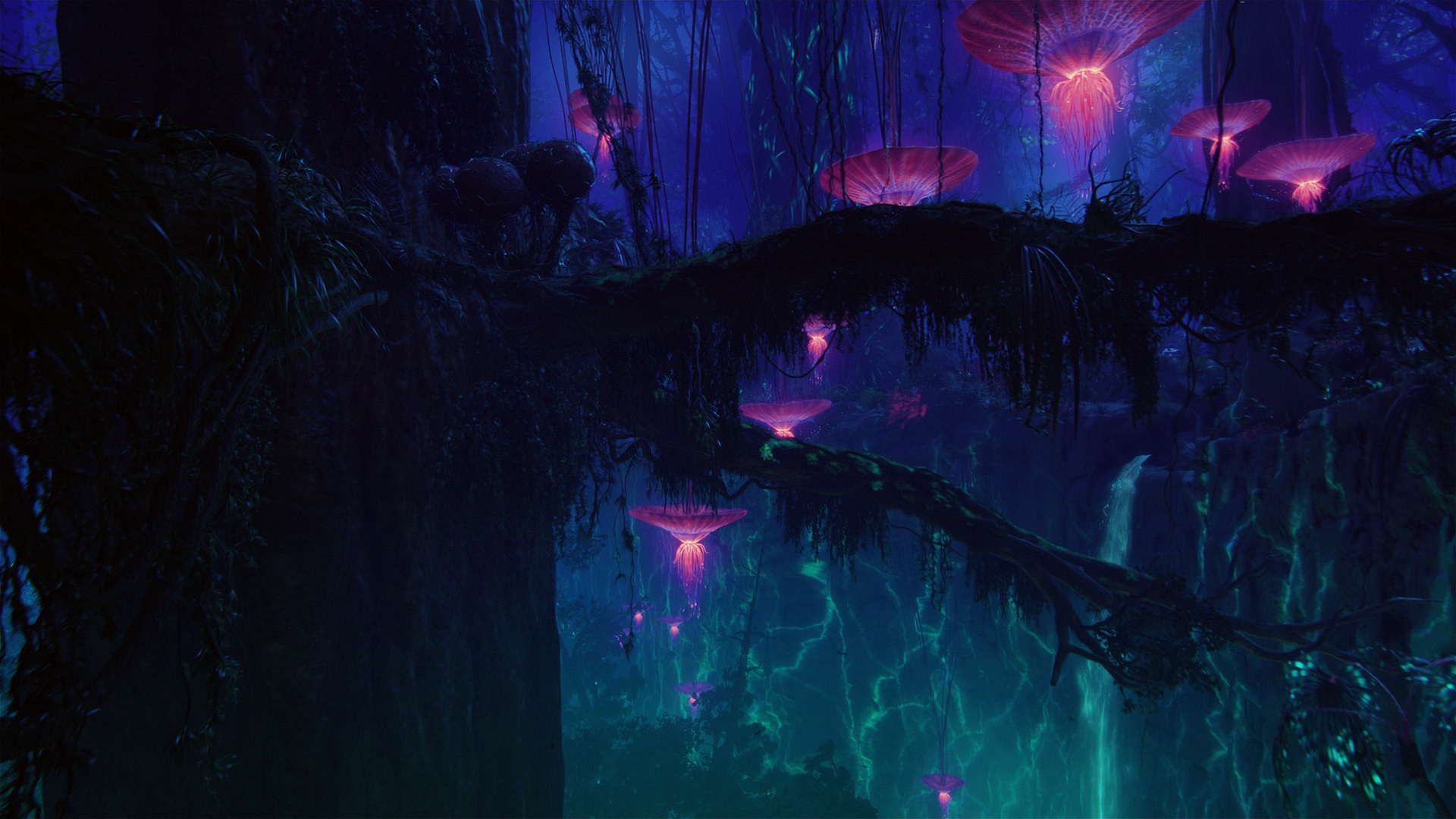
Here is another scene on Pandora. Amongst the many types of Fauna on Pandora are these gargantuan hanging flowers.

The Pandoran flowers could be variations on the simple Fuchsia. The familiarity of the Fuchsia shape overcomes the fantasy element of a much grander scale, and still allows it to be believable.

The Seeds of the Sacred Tree share a resemblance to Dandelion seeds both in looks and
in character.

White, floating, spiderlike seeds that drift with the wind are not unlike dandelion seeds we can see in our gardens, this then allows the Pandoran seeds to feel natural enough to exist.

The Soul tree is one of the most fantastic elements of the Avatar story, allowing the Na’vi to hear the voices of their ancestors.

The Soul Tree becomes believable because it looks like a stylised Willow Tree. Its appearance as a Willow tree makes it believable because it looks familiar.


Suspension of Disbelief is a useful theory for my project as incorporating the natural world with elements of unbelievable fantasy is the main topic of my MA project. Cognitive Estrangement can also be linked to Suspension of Disbelief as it uses the audience’s ignorance or lack of knowledge to support Suspension of Disbelief. Further Research into this would be useful.